
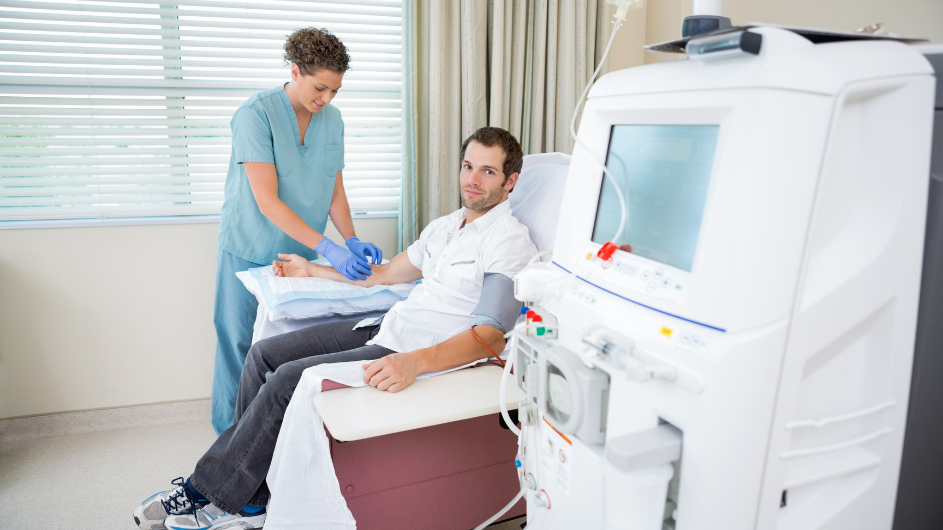
Inpatient and outpatient renal replacement therapy
The Kidney Clinic provides renal replacement therapy — hemodialysis, peritoneal dialysis and CRRT — for both inpatients and outpatients, tailored to each patient's condition and needs.
Inpatient & Outpatient Renal Replacement Therapy
When the kidneys can no longer cope, renal replacement therapy takes over — delivered urgently in hospital or as ongoing, even home-based, care.
What is renal replacement therapy?
Renal replacement therapy (RRT) is the group of treatments that do the kidneys' work — filtering waste and excess fluid from the blood — when the kidneys can no longer do it adequately. We provide RRT both in hospital for acute needs and on an ongoing outpatient basis.
At The Kidney Clinic, Dr. Anil K. Patel and a multidisciplinary team match the method to your condition — from urgent in-hospital dialysis to regular outpatient or home treatment, and on to transplantation where suitable.
Forms of RRT we provide
- Hemodialysis — a machine filters the blood outside the body
- Peritoneal dialysis — the abdominal lining filters the blood
- Continuous renal replacement therapy (CRRT) — slow, continuous dialysis for critically ill patients
- Kidney transplantation — a longer-term alternative to ongoing dialysis
Inpatient vs outpatient
Inpatient RRT
For hospitalised patients with acute kidney injury or severe CKD. Includes hemodialysis, peritoneal dialysis, and CRRT — the slow, continuous option suited to critically ill, unstable patients.
Outpatient RRT
Ongoing dialysis for people with CKD or end-stage renal disease, given regularly outside hospital — in-centre hemodialysis several times a week, or peritoneal dialysis (often daily at home). Home hemodialysis suits some patients too.
Who needs RRT?
RRT may be needed when:
- Acute kidney injury requires urgent support
- Chronic kidney disease has become severe or end-stage
- The kidneys can no longer filter toxins or balance fluid
- You are bridging toward, or awaiting, a kidney transplant
Your RRT journey
Evaluation
Blood tests, urine analysis, imaging, and sometimes a biopsy assess your kidney function and help choose the most suitable form of RRT.
Establishing access
Vascular access for hemodialysis or a peritoneal catheter is set up, depending on the chosen method.
Starting therapy
In-hospital RRT for acute needs, or scheduled outpatient and home dialysis for ongoing care — matched to your stability and lifestyle.
Monitoring & adjustment
Regular checks of fluid balance, electrolytes, and overall health, with your plan fine-tuned as your condition changes.
Toward transplant
Where appropriate, evaluation for kidney transplantation as a longer-term alternative to ongoing dialysis.
Why choose Dr. Anil K. Patel
14+ years of dedicated nephrology and dialysis practice
Specialist training at MPUH Nadiad under Dr. M.M. Rajapurkar
Nephrologists, dialysis specialists, surgeons, and support staff together
Transplant centre partnerships with Mahavir Hospital & Universal Hospital
Inpatient, outpatient, and home dialysis options under one team
Care in English, Hindi & Gujarati, with prompt response
Frequently asked questions
What is inpatient renal replacement therapy (RRT)?
When is inpatient RRT necessary?
What are the types of inpatient RRT?
How is the type of inpatient RRT chosen?
What is outpatient RRT?
Who is a candidate for outpatient RRT?
How often is outpatient dialysis performed?
Can dialysis be done at home?
Are there any risks with RRT?
How can I learn more about my options?
How do I prepare for RRT?
Is a kidney transplant an alternative to RRT?
Need renal replacement therapy?
Speak directly with Dr. Anil K. Patel to understand your options — inpatient, outpatient, or home dialysis, and the path toward transplantation.